Command Responsibility and Isolation
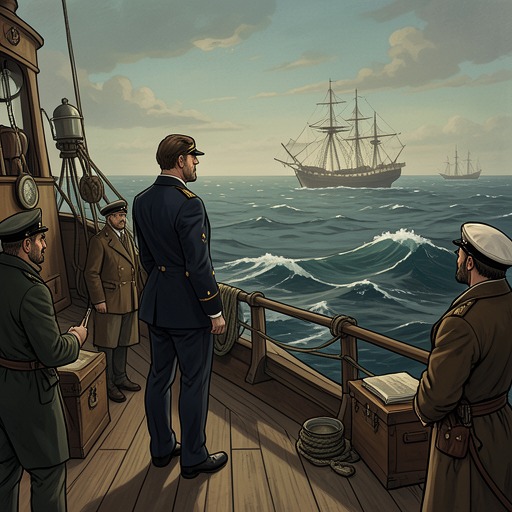
The Good ShepherdCommand Responsibility and Isolation is the governing pressure on George Krause as he commands an Allied convoy: he must make decisions whose consequences extend far beyond his own ship, yet he cannot divide the responsibility or wait for certainty. The narrative measures that burden in lives, fuel, crew endurance, and ammunition, while showing how Krause’s habits of self-command turn isolation into continued work rather than visible drama.
The scale of the burden
The figures attached to Krause’s command establish its material scale without making it adequately measurable. Nearly two thousand people were in the convoy, and more than eight hundred served aboard its four destroyers and escort vessels. The convoy’s safety, along with property valued at fifty million dollars, rested under the responsibility of the forty-two-year-old Commander George Krause of the United States Navy. Yet the narrative resists treating those stakes as an account book. A tanker’s cargo might be worth half a million dollars on paper, but its importance also lay in the fuel it could provide to the British Navy. Material value could be calculated; the wider consequences of a convoy’s safe arrival could not.
The text likewise presents Krause’s personal particulars—his height, weight, and physical condition—not as biographical decoration but as factors in his capacity to reach the bridge and withstand the strain of command. His background also matters: he was the son of a Lutheran minister, had been brought up devoutly, and knew the Bible well. These details establish character and faith as part of the machinery of war, where decisions depend not only on ships and equipment but on the person required to use them. In a brief moment alone after a prolonged stretch of duty, Krause regards his body impersonally, as something to employ in service. The self is not absent from command; it is disciplined into an instrument of it.
Decisions without certainty
Krause’s responsibility becomes most acute when a sonar contact may indicate a U-boat. Sending James to investigate could give the escort a chance to destroy an enemy, but detaching one or two ships would open gaps in a screen that had only four fighting vessels. The pursuit might also consume hours of high-speed steaming and several tons of fuel from a limited reserve, while the convoy continued on without the searching ships. Meanwhile, leaving the contact alone could allow a submarine to report the convoy’s presence, observe its course, or summon other U-boats. No option removes the danger; each rearranges it.
The choice is also political and institutional. Krause is an American officer placed in command of an Allied convoy, with experienced captains of other nations under his orders. He considers how the James’s captain might judge a refusal, how the convoy’s sailors might view a weakened screen, and how governments or officers might later call him either reckless or overcautious. Allied goodwill matters to the larger war effort, but these concerns cannot supply a formula for the immediate decision. They increase the weight of the choice without determining it. Krause grants permission for the investigation, accepting that a judgment made in seconds may be assessed afterward by people who did not have to make it under the same conditions.
That pressure does not justify calling every man to General Quarters. Keeling is already in Condition Two, which keeps much of the ship prepared while maintaining watertight integrity, but a full alarm would interrupt sleep and meals, stop routine maintenance, and exhaust men more quickly. Krause knows that repeated demands without an evident need can also make crews slack in their response. His refusal to sound the alarm is therefore not indifference to danger but a decision about when to spend the crew’s battle reserve. The ship’s readiness depends on preserving human capacity as carefully as fuel or weapons.
Isolation and disciplined attention
The narrative gives Krause’s isolation a religious vocabulary. Faced with a negative sonar report and a message from the outside world, he decides that the message must remain unanswered rather than violate Radio silence for no useful result. The staffs in London and Washington, Bermuda and Reykjavik will remain ignorant while he fights his part of the battle. He recalls a passage from Galatians about each person bearing a burden, and another biblical image of the solitary being placed among families. These allusions make solitude more than physical separation: Krause is surrounded by officers and sailors, yet the responsibility for choosing remains his.
A small exchange makes that separation visible. After Krause returns a message board and thanks Dawson punctiliously, he turns his attention back to the horizon. Dawson alone knows the weight of the news the message contained. He reads Krause’s restrained response with surprise, admiration, and pity, but Krause does not notice the look and would not have understood the admiration. To him, there is nothing extraordinary in doing the duty at hand. The scene distinguishes the leader’s private burden from the meaning others make of his conduct: the subordinate can witness the cost, but cannot take the decision away from him.
This discipline is not uninterrupted invulnerability. A later shock briefly leaves Krause numb; the call over the T.B.S. brings him back to the trained fighting officer, with immediate decisions and responsibilities again before him. His voice conceals the last traces of disturbance, and he searches for an appropriate response to an allied representative. The sequence presents self-command as recovery and action, not as proof that emotion has not affected him.
People and reserves as part of command
Krause’s burden includes the limits of other people’s training and attention. Seven lookouts sweep assigned sectors and must keep their work regular, since a submarine’s periscope may be visible only briefly. Krause checks their performance even when Carling is occupied with taking the ship to its station. The attention that protects the convoy is distributed across individuals, but the captain remains responsible for ensuring that the system is working. Below decks, Tom Ellis has training and months of listening experience, yet has never heard an enemy submarine’s echo. The narrative makes clear that the operator’s ability to recognize and interpret a contact cannot simply be assumed; a failure of practice or composure could compromise an attack.
The same logic governs the rest of the crew. Keeling’s new weapons and instruments, together with the extra sailors required to operate them, strain living space and leave too few trained ratings for three Condition Two watches. Krause divides the company into four sections and arranges watch-and-watch duty, while officers generally work four hours on and eight off. He cancels a routine General Quarters call before dawn so the watch below can receive four hours of rest unless an emergency occurs. This decision reflects his wish to avoid imposing an unnecessary burden, but it is also operational judgment: an exhausted crew cannot indefinitely provide the attention battle requires.
Depletion and the limits of action
The dwindling supply of depth charges makes command responsibility starkly material. After a day in which Keeling has used more than seven tons of explosives, the ship has only six charges remaining; thirty-four have been expended in the latest accounting, and the total for the pattern being reported is thirty-eight. Krause orders an end to firing patterns. The decision closes one immediate option, but continuing to attack with smaller patterns would also reduce the area searched and the chance of success: halving a pattern reduces that chance to a quarter, and dividing it by three reduces it to one-ninth. Even a charge that does not hit may have a deterrent effect, so stopping is not a simple calculation of uselessness. Krause must weigh a possible immediate effect against the need to retain what remains for later danger.
Across these situations, isolation does not mean that Krause acts alone in a literal sense. His decisions depend on reports from operators, the discipline of lookouts, the work of other ships, and the endurance of the crew. But none of those contributions can relieve him of choosing among incomplete, costly alternatives. The narrative’s central contrast is between the many people and resources gathered under his command and the singular responsibility that gathers at the point of decision. Biblical language gives that solitude a spiritual dimension; the repeated calculations of fuel, rest, coverage, and ammunition give it a practical one. Command means carrying both at once.